Real-World Example
Trust dashboard in action
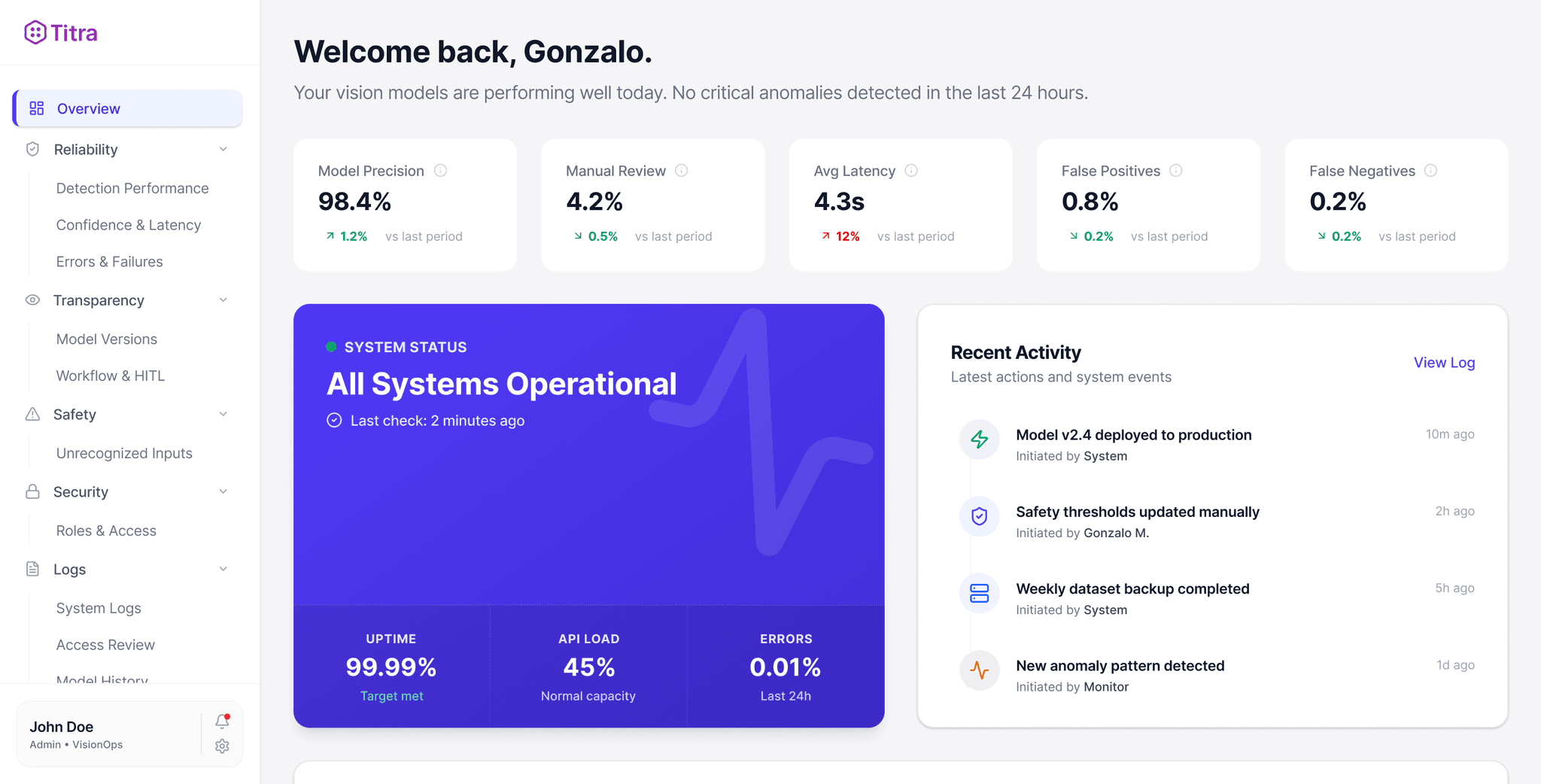
This is Titra — a real trust dashboard built for a computer vision team. It tracks model precision, safety thresholds, latency, and system health using T.R.U.S.S patterns. Your dashboard would reflect your own patterns and production telemetry.
What You Measure
Four pillars, measurable signals
Each trust pillar maps to concrete KPIs that come built-in with the patterns.
Security
Protect against adversarial attacks, data leaks, and unauthorized access.
Safety
Prevent harm through crisis detection and content filtering.
Transparency
Make AI decisions explainable with audit trails and reasoning chains.
Reliability
Ensure consistent outputs through hallucination detection and verification.
From Patterns to Metrics
Every pattern ships with built-in KPIs
When you implement a T.R.U.S.S pattern, you don't just get design guidance — you get a measurement framework. Each pattern defines the metrics that matter, so your team knows exactly what to track from day one.
AI Decision Audit Trail
Reconstruct any AI decision with full context and rationale.
Prompt Injection Shield
Protect the AI from being tricked into ignoring rules or acting outside its scope.
Decision Chain of Thought
The system surfaces a clear, step-by-step reasoning path for AI-driven decisions so users can see how the system moved from inputs to outcome, and what options they have next.
How It Works
From patterns to trust scores
A three-step process that turns pattern adoption into a measurable trust health signal for your organization.
Implement Patterns
Choose patterns from the library based on your risk band and trust pillar needs. Each comes with implementation guidance and design dos/don'ts.
Collect Metrics
Each pattern defines its own KPIs. Instrument your system to capture these signals — from override rates to detection accuracy.
Visualize Trust Health
Aggregate metrics into a trust scorecard. Track trends per pillar, detect regressions, and report trust health to stakeholders.